
Delegates meet in Antalya while the Strait of Hormuz closure raises oil and fertilizer prices and pushes governments to accelerate renewable investment.
MoneyTurkey Politics Desk | 9 November 2026
Key points
- Turkish Environment Minister Murat Kurum said the summit is the first where it is clear the world will overshoot the 1.5-degree target set in the 2015 Paris agreement.
- The war in Iran has effectively closed the Strait of Hormuz, lifting global gasoline, oil, fertilizer and pesticide prices and prompting new spending on wind and solar.
World leaders and climate negotiators opened the United Nations COP31 summit in Antalya, Turkey, on Monday after a year of extreme weather that included deadly heat waves, wildfires and floods in Nepal. The meeting comes as the war in Iran has effectively closed the Strait of Hormuz, driving up prices for oil, gasoline and fertilizer. Delegates will spend the next two weeks trying to convert earlier climate pledges into concrete steps rather than set new targets.
What happened
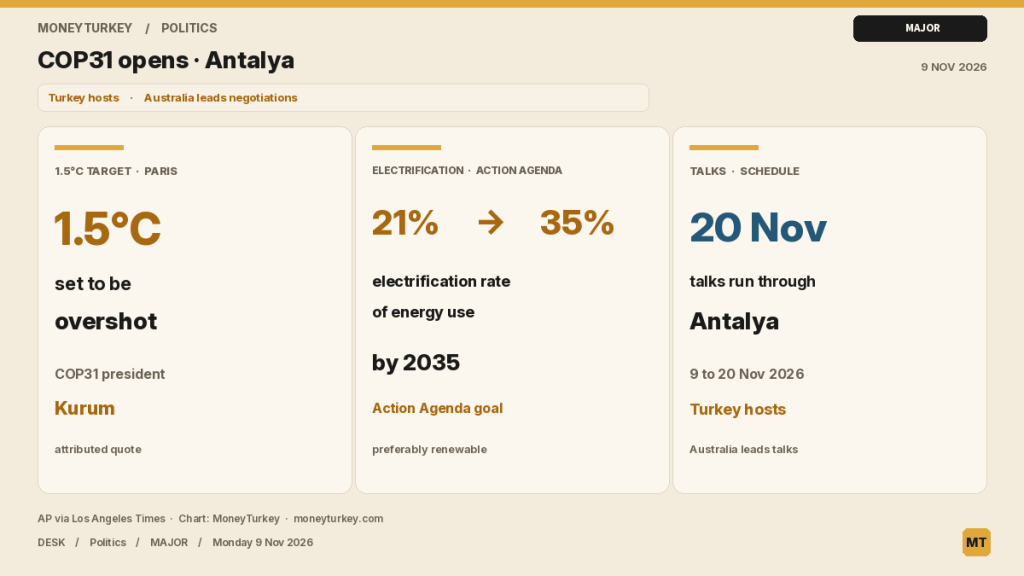
The summit, formally the 31st Conference of the Parties, is taking place in the Turkish Mediterranean resort of Antalya, with negotiations scheduled through 20 November. Turkish Environment Minister Murat Kurum, who holds the COP31 presidency, said: “This is the first COP where it is clear beyond a reasonable doubt that the world will overshoot the 1.5-degree target.”
Kurum told delegates the focus must now shift from new targets to implementation. He unveiled an “Action Agenda” that includes cutting methane emissions and building cities better able to withstand extreme weather. A central theme is electrification: lifting electricity’s share of energy use from 21 percent to 35 percent by 2035, preferably supplied by wind and solar.
The last two summits, COP30 in Brazil and COP29 in Azerbaijan, ended with limited progress on emissions cuts. At COP28 in Dubai, countries agreed to begin a transition away from fossil fuels, but the final texts of the two subsequent meetings did not mention the fuels at all.
The summit is also unusual in who runs it. Turkey is the official host, while Australia is leading the negotiations under a compromise reached after the two jostled to host. Both countries have been criticised for their heavy reliance on coal. The United States, the world’s second-largest polluter after China, is again absent after President Trump withdrew from climate negotiations.
What is at stake for markets
The closure of the Strait of Hormuz has already lifted global prices for crude oil, gasoline and products that rely on them, including fertilizers and pesticides. Governments are responding by increasing short-term spending on renewable power and by reviewing long-term energy security plans.
Higher fertilizer costs threaten farm margins and food-price inflation in import-dependent regions. At the same time, the push to electrify energy demand is expected to channel fresh capital into wind, solar and grid projects, sectors that stand to gain from both policy support and higher conventional-energy prices.
Negotiators will also discuss how to channel funds to poorer countries for adaptation and for the shift away from coal, oil and gas. Any agreement on new finance commitments could affect the cost of capital for energy projects in emerging markets.
Why it matters
Climate scientists have warned that average global temperatures since the early 1800s are on track to rise more than 1.5 degrees Celsius. The overshoot increases the frequency and severity of heat waves, wildfires and floods.
The Hormuz disruption shows how quickly geopolitical shocks can translate into higher input costs for agriculture and manufacturing. Governments have answered by stepping up investment in wind and solar.
Failure to agree on finance and implementation at COP31 would leave existing pledges on paper and could widen the gap between announced targets and actual emissions trajectories.
What to watch
- Any new pledges on adaptation finance for developing countries
- Progress on Kurum’s “Action Agenda” items, especially methane cuts
- Language on fossil-fuel phase-out in the final text
- Signals from major emitters on 2035 electrification targets
Related on MoneyTurkey
- Eisenkot gets mandate to form Israel government as shekel firms before Tel Aviv open
- Europe Wants War Ended Before Security Talks
For information only. Not investment advice.

