
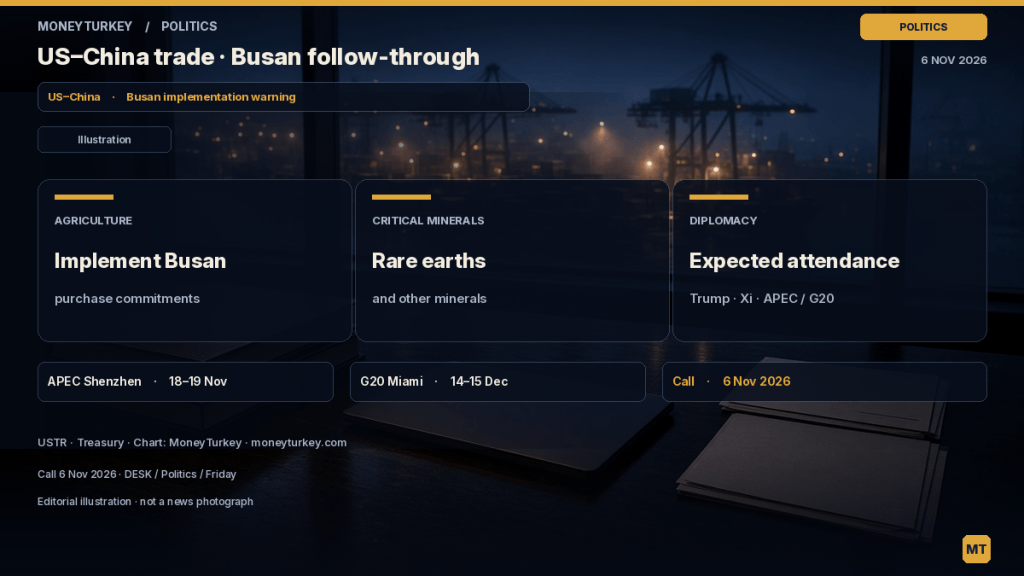
Treasury Secretary Bessent and USTR Greer told Vice Premier He Lifeng that Beijing must deliver on rare earths and farm purchases agreed in Busan last November.
MoneyTurkey Politics Desk | 6 November 2026
Key points
- USTR and Treasury said the 6 November call with He Lifeng focused on agricultural purchases, rare earths and other critical minerals, and on implementing the Busan arrangement.
- A White House fact sheet dated 1 November 2025 said China would buy at least 25 million metric tons of US soybeans in each of 2026, 2027 and 2028.
US Treasury Secretary Scott Bessent and Trade Representative Jamieson Greer told Chinese Vice Premier He Lifeng that Beijing must immediately implement its commitments under the Busan trade agreement, the USTR office said. The call focused on rare earths, other critical minerals and agricultural purchases. The warning comes ahead of the APEC summit in Shenzhen on November 18-19 and the G20 in Miami on December 14-15, where President Trump and President Xi are expected to attend.
What happened
Bessent and Greer spoke with He Lifeng on Friday and stressed the need for concrete action on the Busan pact, the USTR statement said. The arrangement was reached in the Republic of Korea in late October 2025, according to a White House fact sheet dated 1 November 2025. The US officials said they will monitor compliance and assess whether China meets the terms.
Bessent posted that he raised concerns about recent Chinese actions and said progress depends on concrete results. The Treasury statement said the United States would closely assess China’s implementation of the arrangement. The call took place as the two sides prepare for summit windows later this year where Trump and Xi are expected to meet.
Beijing has linked further farm purchases to tariff concessions. Its Commerce Ministry said on Thursday that China is open to buying more US farm goods only if the two sides carry out their reciprocal tariff-cut agreement. Nikkei Asia, citing a proposed package discussed after a September summit, said the two sides had floated about $60 billion of reciprocal tariff cuts that has not been finalized; that package is not restated on the USTR or Treasury call readouts.
What is at stake for markets
Nikkei Asia reported that the Busan deal capped US tariffs on Chinese goods at about 20 percent and expires on January 10; the USTR and Treasury call readouts do not restate those terms. Separately, S&P Global has described a trade truce running through 10 January 2027. If China does not meet the purchase targets, the United States could tighten pressure after that window. The agreement also covers rare earths and other critical minerals that US companies have had difficulty obtaining in sufficient quantities.
The White House said on 1 November 2025 that China would purchase at least 25 million metric tons of US soybeans in each of 2026, 2027 and 2028, after a late-2025 buy of at least 12 million metric tons. In a separate 17 May 2026 fact sheet, the White House said Beijing had agreed to buy at least $17 billion a year of other US agricultural products in 2026 (prorated), 2027 and 2028, in addition to the soybean commitments. Those May figures are not a Busan “boost by $17 billion” print.
US agribusiness groups have urged faster progress on the trade deal. They want Beijing to meet the purchase volumes already agreed. Any shortfall would affect US soybean, pork and other farm exports that rely on the Chinese market.
Why it matters
The Busan agreement was reached after months of tariff escalation between the world’s two largest economies. It set a framework for tariff relief in exchange for specific Chinese purchase commitments. The US side has repeatedly said that compliance on rare earths and farm goods is the test of whether the deal works.
Greer said the administration will pursue balanced trade by monitoring compliance while unlocking benefits for American farmers, ranchers, manufacturers and workers. Bessent and Greer have both cited difficulties US firms face in receiving enough rare earths and critical minerals from China under the current terms.
Whether Trump and Xi meet as expected at APEC and the G20 will shape how markets read the next compliance window. The two sides have not yet finalized the reciprocal tariff-cut package discussed after the September summit.
What to watch
- November 18-19 APEC summit in Shenzhen, where Trump and Xi are expected to attend
- December 14-15 G20 summit in Miami, where a further Trump-Xi meeting is expected
- Whether Beijing delivers on rare-earths and farm-purchase commitments ahead of those summits
Related on MoneyTurkey
For information only. Not investment advice.
Sources
- USTR readout (6 November 2026): https://ustr.gov/about/policy-offices/press-office/press-releases/2026/november/readout-ambassador-greers-call-chinas-vice-premier-he-lifeng
- U.S. Treasury readout (6 November 2026): https://home.treasury.gov/news/press-releases/sb0684
- White House fact sheet (1 November 2025, Republic of Korea / Busan arrangement): https://www.whitehouse.gov/fact-sheets/2025/11/fact-sheet-president-donald-j-trump-strikes-deal-on-economic-and-trade-relations-with-china/
- White House fact sheet (17 May 2026, $17 billion other farm goods annually): https://www.whitehouse.gov/fact-sheets/2026/05/fact-sheet-president-donald-j-trump-secures-historic-deals-with-china-delivering-for-american-workers-farmers-and-industry/
- Nikkei Asia (Reuters byline; secondary on ~20% tariff cap / January expiry / $60 billion package): https://asia.nikkei.com/economy/trade-war/trump-tariffs/us-urges-china-to-meet-rare-earths-commitments-ahead-of-trump-xi-meetings
- Bloomberg: https://www.bloomberg.com/news/articles/2026-11-06/bessent-greer-raise-concerns-on-china-trade-deal-actions
- CGTN / Chinese government calendar (APEC Shenzhen 18–19 November 2026); University of Toronto G20 Information Centre (G20 Miami 14–15 December 2026)

