
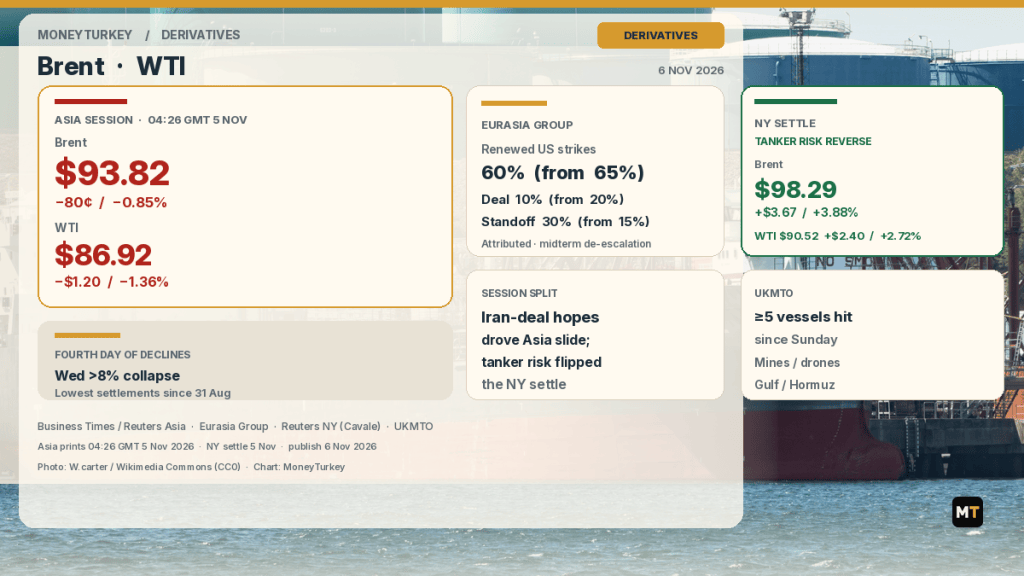
Brent and WTI futures extended a fourth day of declines in Thursday’s Asia session as traders priced a lower chance of further US strikes on Iran after the midterm election results — before tanker attacks reversed the move into the New York settle.
MoneyTurkey Derivatives Desk | 6 November 2026
Key points
- As of 0426 GMT Thursday, Brent was down 80 cents, or 0.85%, to $93.82 a barrel; WTI was down $1.20, or 1.36%, to $86.92 (Business Times / Reuters Asia tape).
- Eurasia Group cut the probability of renewed US strikes on Iran to 60% from 65%, cut the chance of a deal to 10% from 20%, and raised the odds of a continued standoff to 30% from 15%.
- Later Thursday, tanker attacks flipped the session: Brent settled up $3.67, or 3.88%, at $98.29; WTI settled up $2.40, or 2.72%, at $90.52 (Reuters New York).
Oil’s Thursday tape split into two chapters. Early Asia prices extended Wednesday’s more-than-8% collapse — both benchmarks had settled at their lowest since 31 August — as markets weighed Democratic gains in the US midterms as a constraint on further US military action against Iran and a possible path to de-escalation. By the New York close, fresh tanker incidents in the Gulf had restored a supply-risk premium and pushed both contracts higher on the day.
What happened
Wednesday’s sell-off left Brent and WTI at their weakest settlements since late August. Into Thursday’s Asia hours, that slide continued: Brent was last down 80 cents to $93.82 and WTI down $1.20 to $86.92 as of 0426 GMT, according to Reuters copy carried by The Business Times and Arab News. Traders pointed to the midterm outcome — Democrats taking both houses of Congress — as reducing the near-term odds of a full-scale escalation.
Sources close to Gulf government circles told Reuters a weakened White House facing a Democratic Congress able to constrain military options has greater incentive to seek a deal, and that a full-scale assault on Iran now looks less likely. June Goh, senior oil analyst at Sparta Commodities, said markets were pricing a higher chance the war ends while warning that the diplomatic path remains uncertain and strategic reserves are thin.
The afternoon reverse was driven by shipping risk. UK maritime security agency UKMTO reported at least five tankers struck by mines or drones since Sunday, a pace matching October’s record 35 vessel hits. Iran’s Islamic Revolutionary Guard Corps said two oil tankers and a tugboat caught fire after attempting unauthorised routes through the Strait of Hormuz. Saudi Arabia issued alerts for Yanbu, its Red Sea export hub, as Yemen’s Iran-aligned Houthis said they attacked King Fahd airport in Dammam. Brent finished the New York session up $3.67 at $98.29 and WTI up $2.40 at $90.52.
What the futures market is pricing
Eurasia Group lowered its estimate for renewed US strikes on Iran to 60% from 65% and cut the probability of a deal to 10% from 20%, arguing Iran has held firm on demands Trump is unlikely to accept; it raised the likelihood of a continued standoff to 30% from 15%. Separately, Citi flagged that with the midterms over, the White House could lean on executive powers and potentially escalate. Those probability shifts sat under the Asia-session decline even as later tanker headlines re-priced physical disruption risk into the settle.
JPMorgan estimates the global oil market returned to a surplus of 1.1 million barrels per day in September, widening to 1.4 million bpd in October — nearly matching last year’s 1.3 million bpd average — as crude shipments through the Strait of Hormuz recovered close to pre-war levels, though at higher cost. Despite the recent soft patch in prices, Eurasia Group said escalation could still push Brent into a $110–$125 range.
Why it matters
US crude, petrol and distillate inventories all fell last week as demand hit its highest in a year, the Energy Information Administration said Wednesday. Commercial oil inventories in major consuming countries are near their lowest in 15 years, according to Mukesh Sahdev, CEO of energy consultancy XAnalysts. Thin buffers mean futures remain sensitive to both de-escalation hopes and fresh shipping shocks — the same Thursday that showed both forces in sequence.
The war with Iran, which US President Donald Trump launched along with Israel in February, had driven sharply higher fuel prices that became a midterm grievance. With a Democratic Congress taking office in January, energy futures are now a real-time scoreboard for how markets handicap constrained military options versus unresolved Gulf physical risk.
What to watch
- Brent and WTI settlements versus Asia intraday prints
- Eurasia Group probability estimates for US strikes, deal, and standoff
- UKMTO reports on tanker incidents in the Gulf and Strait of Hormuz flows
- EIA weekly inventory and demand data
Related on MoneyTurkey
- VIX Jumps Most Since April as Chip Selloff Reignites Fear Gauge
- BOE Rate Hike Bets Rise After Hawkish Vote
For information only. Not investment advice.
Sources
- The Business Times / Reuters: Oil falls for a fourth day on expectations for lower risk of Iran war escalation
- Arab News / Reuters: Oil falls for a 4th day on expectations for lower risk of Iran war escalation
- Reuters (New York settle / tanker attacks): Siddharth Cavale — Brent finished up $3.67 at $98.29; WTI up $2.40 at $90.52 (5 Nov 2026)
- WSJ (paywalled; headline corroboration): Oil prices fall as Iran peace talks ease supply fears

