
Corporate bond markets in Africa remain thin and concentrated, limiting long-term local financing options.
MoneyTurkey Bonds Desk | 6 November 2026
Key points
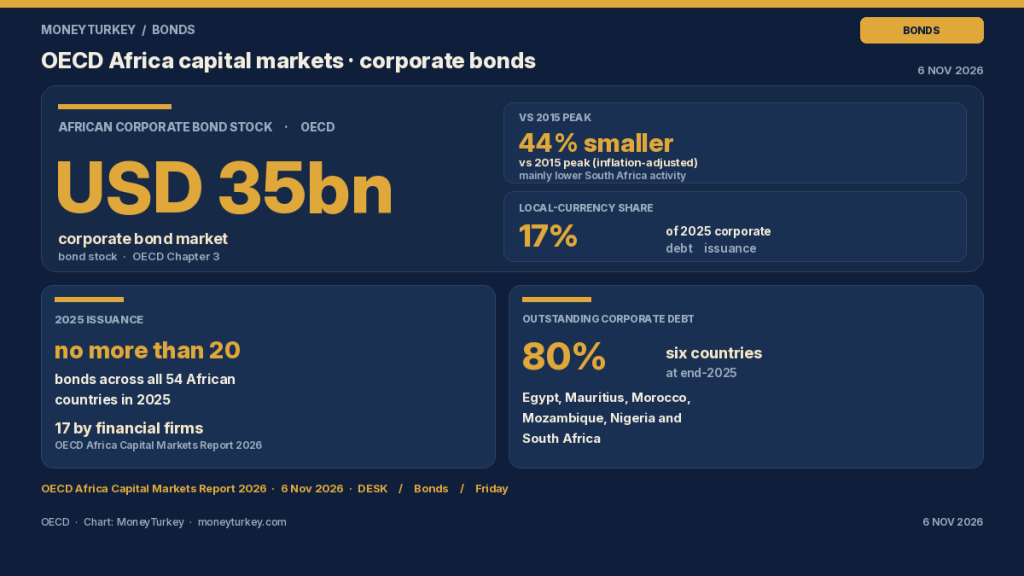
- The African corporate bond market totals $35 billion and is 44% smaller in inflation-adjusted terms than its 2015 peak, mainly because of lower South African activity.
- Companies across the continent issued no more than 20 bonds in 2025, 17 of them by financial firms, and only 17% of that debt was denominated in local currency.
The OECD’s Africa Capital Markets Report 2026 finds that corporate bond markets across the continent remain shallow and concentrated in six countries. The shortfall limits companies’ ability to secure long-term funding without currency risk and reduces resilience when foreign lenders retreat. Equity markets grew faster, but debt markets did not keep pace.
What happened
The OECD estimates the total African corporate bond market at $35 billion. After inflation adjustment, that stock is 44% smaller than its 2015 peak, largely because of reduced issuance in South Africa. Six countries—Egypt, Mauritius, Morocco, Mozambique, Nigeria and South Africa—account for 80% of outstanding corporate debt.
In 2025, issuers across all 54 African countries sold no more than 20 bonds. Seventeen of those deals came from financial firms. Only 17% of the debt was denominated in local currency, leaving most borrowers exposed to exchange-rate moves.
The report draws on bond and loan records from LSEG and private-credit data from Preqin. It notes that regulatory quality, rule of law, exchange-rate stability and the presence of pension funds are the factors most closely tied to deeper bond markets.
What is moving yields
The OECD links thin domestic markets to higher borrowing costs when external funding dries up. Without local-currency benchmarks, pricing for new issues lacks depth and liquidity, pushing spreads wider for both sovereign and corporate borrowers.
The report adds that more than 25% of official development aid to sub-Saharan Africa has been cut, increasing the need for domestic capital markets to fill the gap. Equity market capitalisation rose 49% in 2025, more than twice the gain in broader emerging markets, but debt markets did not follow.
Why it matters
Shallow corporate bond markets constrain long-term finance for infrastructure and industry. When global risk appetite fades, companies and governments that rely on foreign lenders face sudden funding gaps. The OECD says policymakers need a whole-of-government approach to improve regulatory frameworks and develop local institutional investors.
Three-quarters of large non-financial state-owned enterprises remain unlisted, representing a potential pool of assets that could deepen both equity and debt markets if brought to local exchanges.
What to watch
- New local-currency corporate issues in Egypt and Nigeria
- Pension-fund rules that could channel more domestic savings into bonds
- Regulatory changes aimed at improving disclosure and settlement
- Further listings of state-owned firms on African exchanges
Related on MoneyTurkey
- JGB 10-Year Yield Hits June Low as Tech Selloff Fuels Haven Bid
- Japan GPIF Posts First 5.25 Trillion Yen Loss in Six Quarters as Foreign Bonds Slump
For information only. Not investment advice.

