
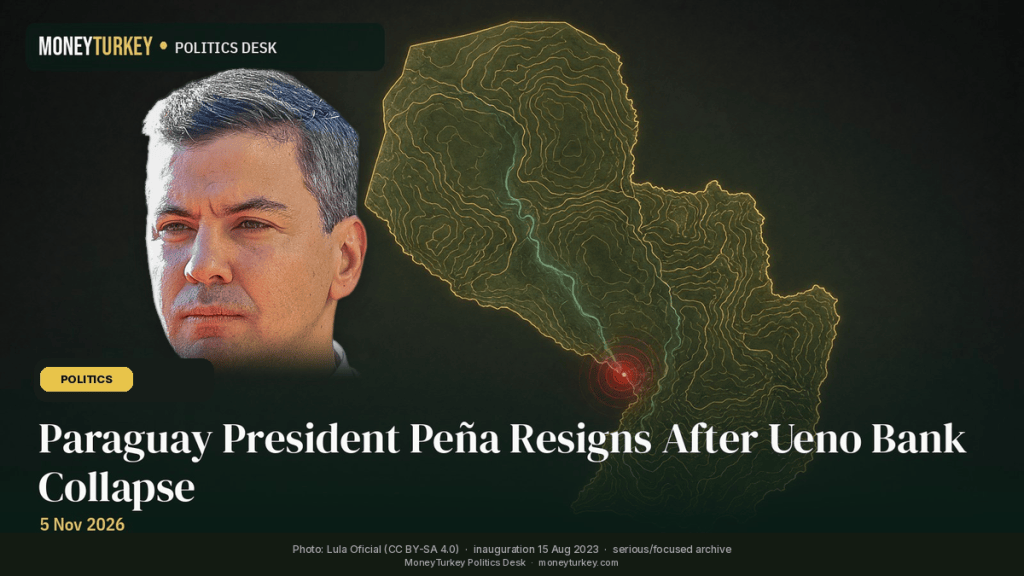
Santiago Peña steps down as congress moves to impeach him over conflict-of-interest claims tied to the failed digital lender.
MoneyTurkey Politics Desk | 5 November 2026, 18:55 GMT
Key points
- Ueno Bank held nearly three million accounts, about 60 percent of Paraguay’s adult population, and managed public pension and health-fund deposits.
- The central bank seized the lender after its solvency ratio fell below half the legal minimum; eight executives were detained and prosecutors charged 27 officials and associates.
Paraguayan President Santiago Peña resigned Thursday after the collapse of Ueno Bank, a digital lender he owned shares in until 2025. The bank’s insolvency froze accounts for roughly three million customers, about 60 percent of the adult population, and left pension and health-fund deposits inaccessible. Paraguay’s lower house had voted to open an impeachment trial; Peña said he was stepping down to protect stability, social peace and democratic institutions.
What happened
Ueno Bank entered resolution proceedings earlier this week after its solvency ratio fell below half the legal minimum, ABC Color reported. The central bank intervened, seized the lender and began moving customer accounts to other institutions. Eight Ueno executives were detained and prosecutors charged 27 bank officials and associates, La Nación and ABC Color reported.
Peña held shares in Ueno Holding until last year. Opposition lawmakers accused him of conflicts of interest and misuse of public funds. Former President Horacio Cartes, a senior figure in Peña’s Colorado Party, backed the impeachment effort, ABC Color reported.
Peña rejected suggestions of impropriety. In a video posted on X, he apologised to Paraguayans if he had failed to meet expectations and said his priority was ensuring depositors recover their savings and public funds are protected.
What is at stake for markets
Ueno Bank managed large amounts of public money, including pension and health-fund deposits. Industry groups had put public and pension deposits at the lender above $860 million before the freeze, ABC Color reported. Millions were unable to access accounts, and street protests followed in the capital.
The central bank has appointed a new president and Congress has approved a process to repay depositors. Authorities are transferring customer accounts to other banks to limit the fallout.
The episode has raised questions about oversight of digital lenders and the handling of public-sector deposits in Paraguay’s financial system.
Why it matters
Peña took office in August 2023 for a five-year term after winning election as the Colorado Party candidate. His resignation marks a political setback for the ruling party as it tries to contain the financial and institutional damage.
The crisis has exposed governance risks in a country where one lender served a majority of adult savers and held public funds. Restoring confidence in the banking system and completing the transfer of deposits are now the immediate priorities for authorities.
What to watch
- Progress on account transfers and repayment timeline
- Colorado Party response and any leadership changes
- Central bank statements on liquidity and depositor protection
Related on MoneyTurkey
For information only. Not investment advice.
Sources
- BBC: Paraguay President Santiago Peña resigns after bank collapse
- ABC Color: Renunció Santiago Peña: la caída del Presidente por el caso Ueno Bank
- La Nación (Paraguay): Fiscalía imputó a 27 directivos de ueno y empresas vinculadas
- AP: Paraguayan President Peña impeached minutes after resigning following bank collapse
- Al Jazeera: Paraguay president Peña resigns in wake of bank collapse
- CNN: Paraguay president resigns amid bank collapse crisis

