
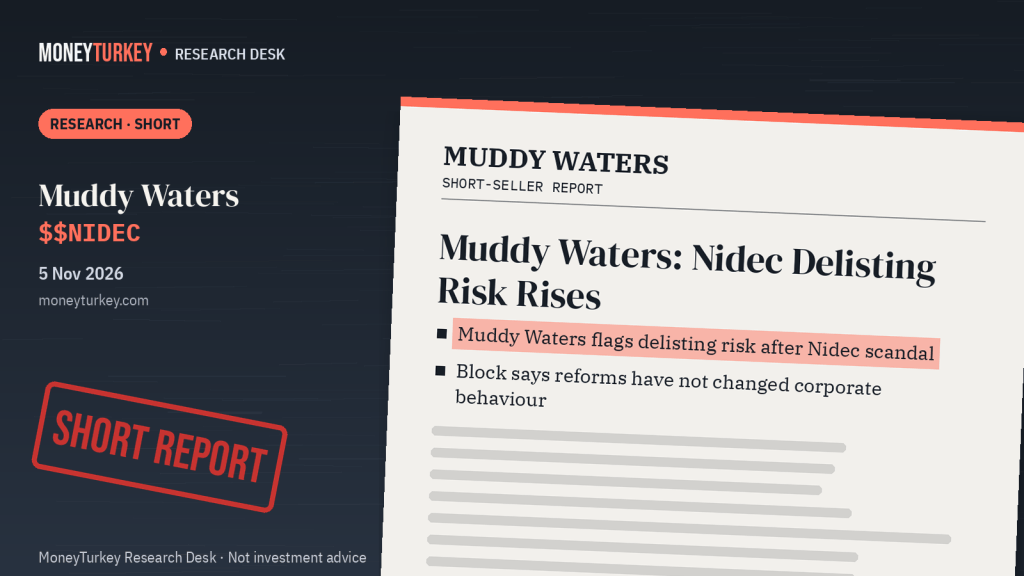
Ten years after his short on Nidec, Muddy Waters’ Carson Block says the motor maker’s accounting scandal shows Japan’s corporate reforms have not gone far enough — and that delisting risk from the Tokyo Stock Exchange is real.
MoneyTurkey Research Desk | 5 November 2026
Key points
- Carson Block says Nidec’s scandal exposes the limits of Japan’s governance overhaul and raises the odds of a TSE delisting.
- Nidec missed its late-October target for an unqualified auditor opinion; the exchange is reviewing whether to keep the stock listed.
- Write-downs tied to the probe total about ¥632 billion (about $4 billion); the shares have fallen more than 30% since the October 2025 special-alert designation.
Block’s comments, carried by Bloomberg via The Japan Times on 5 November 2026, land a decade after Muddy Waters first flagged aggressive accounting and governance problems at Nidec. The short seller says the latest disclosures prove that reform announcements have not changed incentives or accountability at the firm.
The call
Muddy Waters argues that Nidec faces a higher risk of delisting after failing to secure an auditor’s opinion on its fiscal 2025 securities report. Block links the episode directly to what he calls deeper dysfunction in parts of Japan Inc: “There are a number of problematic companies, and it’s a market where people just haven’t really been held accountable,” he said in an online interview.
Nidec has been under a Tokyo Stock Exchange special alert since October 2025. The company said on 29 October 2026 that it could not obtain an unqualified opinion from PwC Japan by its end-of-month target, and that it would still file an internal-control document for the exchange’s review. That review can take several months and can end in the alert being lifted, kept in place, or a delisting.
The reasoning
Block says the external investigation into Nidec did not go far enough back into the years when Muddy Waters first raised red flags in 2016. Write-downs after the probe total about ¥632 billion (about $4 billion) for the year ended 31 March. Shares have traded near decade lows, down more than 30% since the special-alert designation.
The note sits apart from most of today’s bank research, which is still chasing price targets. Citi has flagged a $150 Brent stress case if the Strait of Hormuz stays blocked, while Goldman Sachs, JPMorgan and Morgan Stanley each carry an 8,000 year-end S&P 500 target. Muddy Waters is not calling a level — it is questioning whether Japan’s reform push changes behaviour when a major industrial name fails a basic audit test.
What to watch
- TSE’s decision after it reviews Nidec’s internal-control filing
- Whether PwC Japan later issues an unqualified opinion, and on what timetable
- Any further disclosures on how far back the accounting irregularities run
- Follow-on commentary from other short sellers or Japan governance funds
Related on MoneyTurkey
- Morgan Stanley Sees S&P 500 Drop 9% Before Rebound to 8,000
- Goldman Sachs Lifts 2026 Brent Forecast to $85 on Tighter Supply
For information only. Not investment advice.
Sources
- The Japan Times / Bloomberg (Block interview, 5 Nov 2026): japantimes.co.jp
- The Japan Times (Nidec misses auditor-opinion target, 29 Oct 2026): japantimes.co.jp
- CNA / Reuters (amended accounts target miss): channelnewsasia.com

