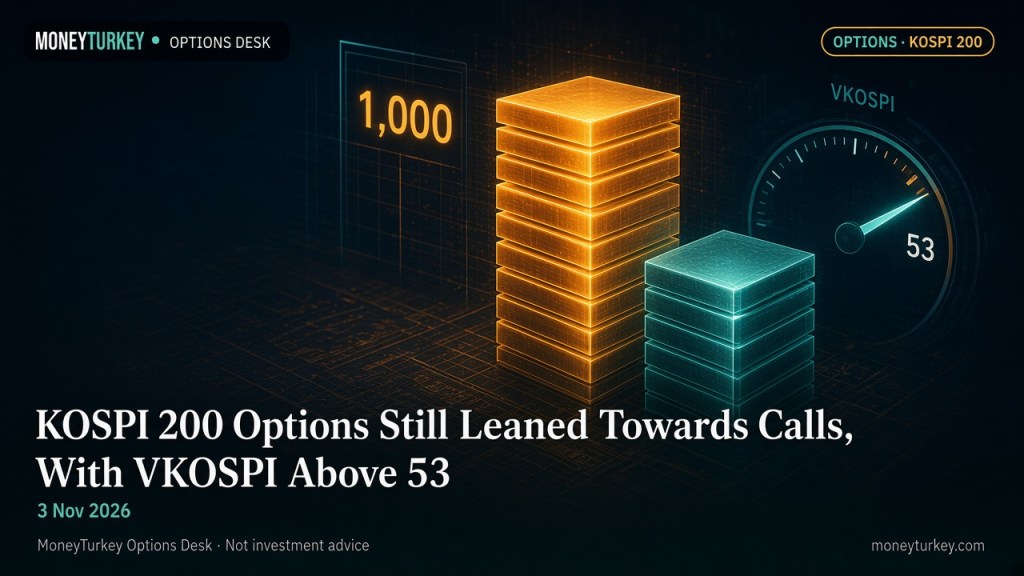
Before Tuesday’s sell-off, the November KOSPI 200 options book held about two calls for every put, with its largest call position at the 1,000 strike and Korea’s fear gauge at 53.34. After the index fell to 885.67 on 3 November, that call wall and the 940 max-pain level are both well above the market, eight trading days before the 12 November expiry.
By MoneyTurkey Options Desk
Key points
- At the 2 November close, the November KOSPI 200 index options held 132,160 calls and 60,058 puts of open interest (OI), the number of contracts still outstanding. That is a put/call OI ratio of 0.45. The book leaned towards calls but was far more balanced than SK Hynix’s single-stock options, which held about 28 calls for every put.
- The largest call position, 7,425 contracts, was at the 1,000 strike, about 8.6% above the 2 November spot level of 920.63. After the cash KOSPI 200 fell 34.96 points to 885.67 on 3 November, that strike is about 12.9% above the market.
- VKOSPI, the Korea Exchange’s (KRX) implied-volatility index for the KOSPI 200, closed at 53.34 on 2 November, above its 50-day average of 47.52. The 3 November reading had not been published at the time of writing.
- Data note: KOSPI 200 option OI and investor-flow figures in this article are from the 2 November close. OI for the 3 November session could not be verified at the time of writing. Index, futures, share-price and currency figures are from 3 November.
The Korea Composite Stock Price Index (KOSPI) fell 210.29 points, or 3.59%, to 5,648.79 on Tuesday 3 November, Yonhap reported. At one point it was down 4.15%, at about 5,615.80. The KOSPI 200, the large-cap index that underlies Korea’s benchmark futures and options, closed at 885.67, down 34.96 points, or about 3.8%, according to KRX data published by Yonhap Infomax.
Going into the fall, the index options book did not show heavy demand for downside protection. Call OI was more than double put OI, and foreign investors were net buyers of call premium on 2 November. Until KRX publishes 3 November OI, it is not clear how much of that positioning was closed, rolled or hedged during the sell-off.
What happened
US technology stocks fell again overnight amid doubts about the returns on heavy artificial-intelligence spending. The Philadelphia Semiconductor Index fell 3.4% after a 7.2% drop on Friday, and investors were cautious ahead of voting in the US midterm elections, Yonhap said.
“Concerns about profitability of AI investments persist,” Kim Seok-hwan, an analyst at Mirae Asset Securities, told Yonhap. “A sharp drop in chip shares in the U.S. stock market on the first trading day of November weighed heavily on the Korean market.”
Chip shares, which carry a large weight in the KOSPI 200, led the decline. Samsung Electronics fell 4.15% to â‚©219,500, and SK Hynix fell 5.03% to â‚©1.4m (â‚©1,398,000). Foreign investors sold a net â‚©1.5tn of KOSPI shares and institutions a net â‚©511.7bn, while individuals bought a net â‚©1.7tn, Yonhap reported. The won was quoted at 1,341 per dollar at 15:30 Korea time, 2.8 won firmer than the previous session.
In futures, the front quarterly KOSPI 200 contract (December 2026) closed at 885.15, down 33.50 points, or 3.65%, on volume of 110,672 contracts, according to the same KRX table. It opened at 897, reached a high of 899.20 and a low of 879.35. That left futures about 0.52 points below the cash index, a discount known as backwardation. On 2 November, the contract closed at 918.65 against a cash level of 920.63.
The options book
The figures below are from the 2 November close. They were compiled from KRX data by the independent KOSPI Monitor dashboard, whose report was generated at 08:30 Korea time on 3 November (23:30 GMT on 2 November).
- Expiry: the front monthly contract (code 202611) expires on Thursday 12 November, the second Thursday of the month. As of 2 November, that was eight business days and 10 calendar days away. KOSPI 200 options are European-style, so they can be exercised only at expiry, and cash-settled, with a multiplier of â‚©250,000 per index point, according to KRX.
- Call/put split: November call OI was 132,160 contracts and put OI 60,058, giving a put/call OI ratio of 0.45 (0.4544). The put/call ratio divides put OI by call OI, so a reading below 1 means more calls are outstanding than puts.
- Change on the session: compared with 30 October, on matched strikes in the same expiry, call OI rose by 4,424 contracts and put OI by 647.
- Call wall: the largest call position across the whole chain was at the 1,000 strike, with 7,425 contracts, about 8.62% above the 2 November spot level. A “call wall” is the strike with the largest call OI. Traders watch it as a level where hedging by option dealers may be concentrated, although OI alone does not show who is long or short.
- Put side: the largest put position across the whole chain was at the 750 strike, with 5,968 contracts, about 18.5% below spot on 2 November. Closer to the market, the 950 strike held the most put OI, with 3,886 contracts.
- Max pain and the at-the-money strike: traditional max pain, the expiry level at which option holders as a group would lose the most, was 940. The at-the-money strike, the one closest to the index level, was 920.
- Exposure: the strikes with the largest estimated dealer gamma exposure, a measure of how much hedging may change as the index moves, were 1,000, 850, 950, 925 and 870, KOSPI Monitor said.
Two smaller books showed the same tilt. Mini-KOSPI 200 November options had 34,013 calls and 22,959 puts outstanding, a put/call ratio of 0.68. The Thursday weekly contract expiring on 5 November (code 2611W1) held 12,785 calls and 3,210 puts, a ratio of 0.25, with its largest call position at the 927.5 strike (3,221 contracts).
Who was trading
KRX investor data for 2 November, covering all listed KOSPI 200 option expiries and compiled by KOSPI Monitor, show foreign investors as the main buyers of calls:
| Investor | Calls, net contracts | Calls, net premium | Puts, net contracts | Puts, net premium |
|---|---|---|---|---|
| Foreigners | +652 | +₩3,473m | −248 | −₩591m |
| Individuals | −275 | +₩112m | +256 | −₩573m |
| Institutions | −377 | −₩3,585m | −8 | +₩1,164m |
Source: KRX investor data via KOSPI Monitor, 2 November 2026. Positive figures are net buying.
Foreigners added calls and cut puts on the day before the sell-off. Institutions were net sellers of call premium, roughly matching the foreign buying, while individuals were small net buyers of puts.
Why it matters
A put/call ratio of 0.45 is call-heavy but not extreme. SK Hynix’s November single-stock options, which MoneyTurkey covered earlier on Tuesday, had a ratio of 0.036 on the same date, and most of those calls sat at one deep in-the-money strike. That pattern looked mechanical, consistent with calls being used as a substitute for owning the stock. The index book is spread across more strikes and has more puts, so it fits more closely with ordinary hedging and directional positioning.
The sell-off has changed where the market stands relative to that book. On 2 November, the 1,000 call wall was 8.6% above spot. At Tuesday’s close of 885.67, it is about 12.9% above. For the index to reach it by 12 November, the KOSPI 200 would need to recover all of Tuesday’s losses and then rise about another 8.6%. Max pain at 940 is about 6.1% above the 3 November close. The 920 strike, at the money on 2 November, and the 950 strike, which had the most near-the-money put OI, are now both above the market, so puts at those strikes are in the money.
The 750 put wall is still about 15% below the 3 November close. Between the market and that strike, the 850 and 870 strikes were among the levels with the largest estimated gamma exposure on 2 November. With few trading days left, option values and dealer hedges become more sensitive to moves around those strikes.
KOSPI Monitor notes that OI concentration “does not confirm actual support or resistance, a price target, or a directional signal”. The 2 November figures show where positions were before the fall, not where they are now.
VKOSPI and the fear gauge
VKOSPI is the KRX’s model-free measure of the volatility that KOSPI 200 option prices imply over roughly the next 30 days. It is Korea’s counterpart to Wall Street’s VIX. A higher reading means option prices imply larger moves in either direction, and the index usually rises during sell-offs.
VKOSPI closed at 53.34 on 2 November, up 1.02 from 52.32, according to Korea Fear & Greed, which publishes KRX data with a one-day lag. The Kred data series shows the same figure. That was above the 50-day average of 47.52 but well below the 2026 high of 96.94, set on 29 June, which is also the highest close since at least 2014. VKOSPI has averaged 59.36 so far in 2026, compared with 24.08 in 2025, so the 2 November reading was high by historical standards but below this year’s average.
The 3 November close had not been published when this article was filed. Given the size of Tuesday’s fall, Wednesday’s release will show how far the options market repriced volatility after the sell-off.
What to watch
- 3 November OI: whether KRX data show the November call book being cut after the fall, and whether put OI rises, especially at the 850–900 strikes.
- VKOSPI on 3 November: how far the reading rises above 53.34 and the 50-day average of 47.52.
- Thursday 5 November weekly expiry: the 2611W1 contract’s largest call position, at 927.5, was about 4.7% above Tuesday’s close.
- Foreign flows: whether foreigners, who bought call premium on 2 November and sold â‚©1.5tn of KOSPI shares on 3 November, keep selling shares or move into index puts.
- Futures basis: whether the December futures discount to the cash index, about 0.52 points on 3 November, widens.
- 12 November expiry: where the KOSPI 200 settles relative to the 940 max-pain level and the 1,000 call wall, and how much November OI rolls into December.
- US overnight: the US midterm elections and chip stocks will set the tone for Seoul on Wednesday.
Sources
- Yonhap (English): Seoul shares dip over 3 pct amid escalating AI woes (3 November 2026)
- Yonhap (Korean): KOSPI falls 3.6% on US tech slide (3 November 2026)
- Yonhap / Yonhap Infomax (Korean): KOSPI 200 futures and options price table, data from KRX (3 November 2026)
- KOSPI Monitor (Korean): options-by-product summary, data date 2 November 2026, compiled from KRX
- Korea Fear & Greed: VKOSPI, close of 2 November 2026, source KRX
- Kred: VKOSPI data series (KRVKOSPI)
- Korea Exchange (KRX Global): KOSPI 200 options contract specifications
This article is for information purposes only and does not constitute investment advice. MoneyTurkey does not recommend buying or selling any security, option or other financial instrument. Options carry a high risk of rapid loss.

