
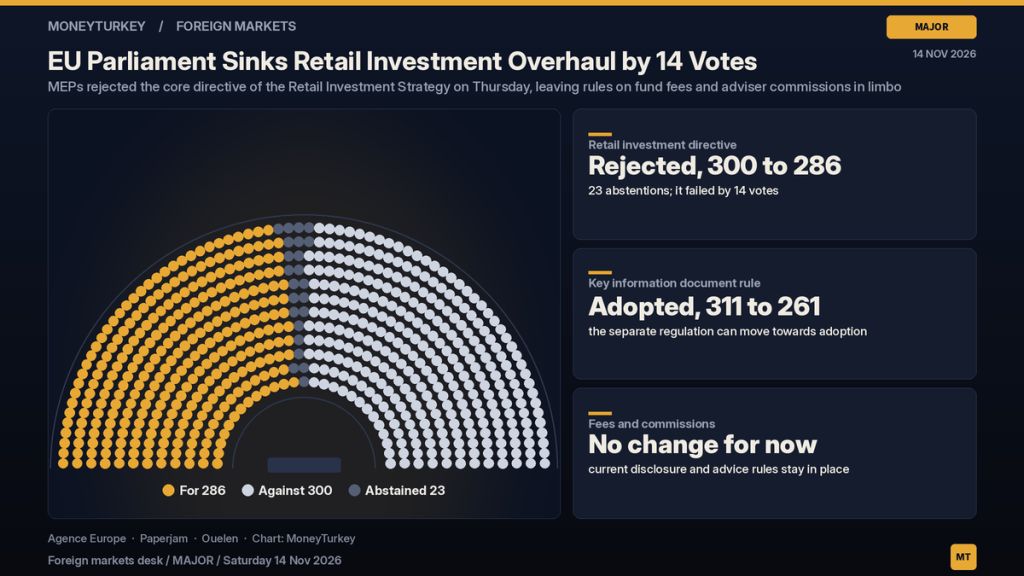
The European Parliament has voted down the core of the EU’s retail investment reform by 14 votes, leaving rules on fund fees and adviser commissions in limbo and handing Europe’s asset managers and insurers an unexpected reprieve.
MoneyTurkey Foreign Markets Desk | 14 November 2026
Key points
- MEPs rejected the Retail Investment Strategy omnibus directive on Thursday by 300 votes to 286, with 23 abstentions, according to Agence Europe, L’Agefi and Les Echos.
- The text had been agreed with EU governments in December 2025 and backed by Parliament’s economic affairs committee in June.
- A separate regulation updating the key information document for packaged investment products passed by 311 votes to 261 and can move towards adoption.
- The European Commission said it “deeply” regretted the result and would consider next steps.
What happened
Lawmakers in plenary rejected the compromise directive that sits at the heart of the Retail Investment Strategy, the package the Commission proposed in 2023 to protect individual savers and steer more household money into capital markets. Les Echos called it a “cold shower” for the EU’s Savings and Investments Union, noting that the vote came as a surprise to most of Brussels.
The socialists, greens and the left voted against and were joined by enough centre-right and conservative members to tip the balance, Agence Europe reported. Among them was German Christian Democrat Markus Ferber, the European People’s Party’s negotiator on the file, who had backed the deal in committee. “This is not a vote against retail investors,” Ferber said. “It is a vote in favour of rules that work. We have prevented a ban on inducements.” He asked the Commission for “a lighter approach”.
The Parliament’s rapporteur, French Renew member Stéphanie Yon-Courtin, said on X that “finfluencers can say thank you” and accused French socialist and centre-right MEPs of putting political posturing before the public interest, according to Agence Europe.
Why markets care
The directive would have amended five pieces of EU financial law, including MiFID II, the UCITS and AIFMD fund rules, the insurance distribution directive and Solvency II, law firm Arthur Cox said in a client note. Its most contested part was a “value for money” test: fund makers would have had to show that their fees were reasonable against peer groups of similar products, and a product failing the test could not be sold to retail investors, Paperjam reported. There was no EU-wide fee cap.
The compromise also tightened the rules on inducements, the commissions that fund houses pay banks, insurers and advisers for selling their products. Advisers in several EU countries rely on such payments, Agence Europe noted. With the directive voted down, current rules on disclosure and advice stay in place and fees are not capped or changed by the vote, Club Patrimoine and the French savings site Ouelen said. That removes a compliance and margin overhang for asset managers, insurers and bank distribution networks, but leaves the industry without the clarity it had planned around.
What comes next
A parliamentary source told Agence Europe there are three options: approve the Council’s position at first reading, reject it and end the file, or send it back to the economic affairs committee. A referral would allow up to four months of renewed talks with member states. Law firm Linklaters said parts of the package could instead be folded into other files such as the Market Integration and Supervision Package, or the dossier could stall.
What to watch
- Whether Parliament refers the directive back to the economic affairs committee
- The Commission’s next steps on value for money and inducements
- Any attempt to move parts of the reform into the Market Integration and Supervision Package
- Formal adoption of the key information document regulation
For information only. Not investment advice.
Sources
- Les Echos: https://www.lesechos.fr/finance-marches/banque-assurances/coup-de-theatre-a-bruxelles-le-parlement-europeen-torpille-le-coeur-de-la-reforme-sur-lepargne-2262590
- Agence Europe: https://agenceurope.eu/en/bulletin/article/13980/6/european-parliament-rejects-one-text-in-retail-investment-package-deal-reached-with-eu-council
- L’Agefi: https://www.agefi.fr/asset-management/actualites/le-parlement-europeen-rejette-les-regles-de-protection-des-investisseurs-de-detail
- Paperjam: https://en.paperjam.lu/article/value-for-money-derails-savings-reform
- Club Patrimoine: https://www.clubpatrimoine.com/contenus/ris-europe-rejet
- Ouelen: https://www.ouelen.com/2026/11/14/reforme-europeenne-de-lepargne-le-parlement-rejette-la-ris-a-14-voix-pres/
- Linklaters: https://financialregulation.linklaters.com/post/102o9f4/european-parliament-rejects-major-retail-investment-strategy-reforms
- Arthur Cox: https://www.arthurcox.com/insights/eu-retail-investment-strategy-parliament-rejects-directive-but-approves-priips-reforms/

