
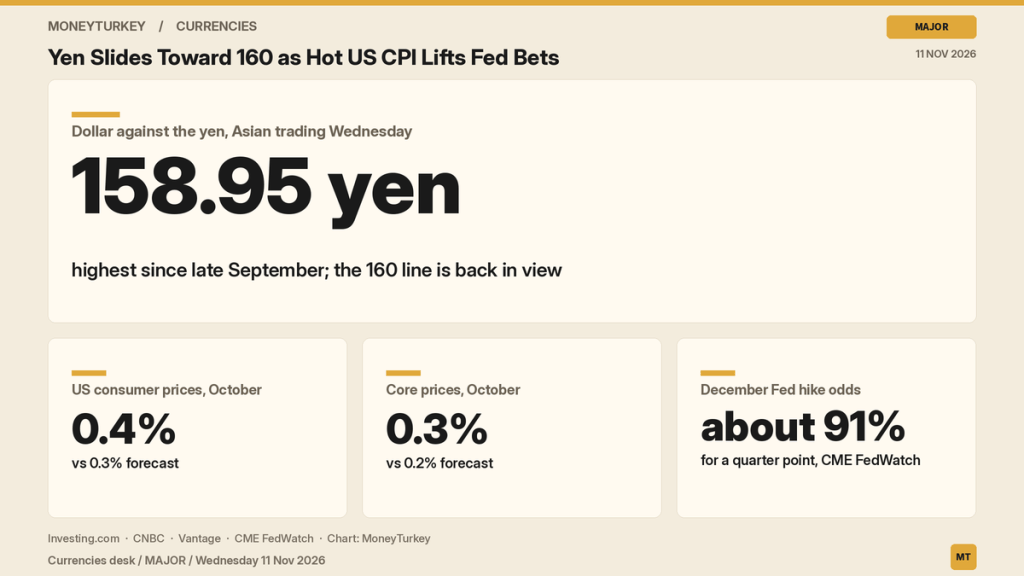
The yen slipped to its weakest against the dollar since late September after hotter US inflation hardened bets on a December Fed hike, putting the 160 line that Tokyo has defended before back in view.
MoneyTurkey Currencies Desk | 11 November 2026
Key points
- The dollar rose as high as 158.95 yen in Asian trading on Wednesday, its strongest since late September, leaving the yen near a six-week low.
- US consumer prices rose 0.4% in October against forecasts of 0.3%, and core prices rose 0.3% against 0.2%.
- Markets price about a 91% chance of a quarter-point Fed hike in December and about 10% for a half-point move, according to CME FedWatch data.
The US dollar index held near a two-week high around 102.30 on Wednesday, Investing.com and Economy Middle East reported, after the October inflation figures from the Bureau of Labor Statistics on Tuesday came in above expectations. Headline prices rose 0.4% on the month and core prices, which strip out food and energy, rose 0.3%, both a tenth of a point above forecasts.
What happened
The yen weakened through the US session on Tuesday and the dollar pushed on to 158.95 yen in Asia on Wednesday, according to Investing.com and broker ATFX, the highest since late September. FXStreet put the pair around 158.90 during Asian hours. The yen later steadied a little, but stayed close to its six-week low.
The Australian dollar edged up after touching a seven-month low against the US dollar on Tuesday, Investing.com and Economy Middle East reported. Softer oil prices offered some relief to Asian energy importers, but rising US yields and a firmer dollar limited any gains.
What is driving the move
Fed officials added to the pressure. Governor Christopher Waller said on Tuesday he would support a December rate increase even if inflation cooled, and that a larger half-point move should be considered if price pressures worsened. Dallas Fed President Lorie Logan said the central bank needed at least two more quarter-point increases, according to Investing.com and Economy Middle East.
CME FedWatch data showed about a 91% chance of a quarter-point December hike, up from 84% on Monday, with the odds of a half-point move rising to about 10%, Investing.com reported. FXStreet and ATFX gave similar readings. A wider gap between US and Japanese rates tends to weigh on the yen.
Goldman Sachs now expects the Fed to go further. The bank still sees a quarter-point hike in December and has added a third in March 2027, which would lift the federal funds rate to a peak of 4.25% to 4.5%, Goldman said in a note, according to Investing.com and CNBC-e. It also pushed its forecast for the first rate cut back a quarter, to December 2027.
The view from Tokyo
MUFG’s Derek Halpenny said in a note that the yen “weakened sharply” after the US data and that the dollar is back near 160 yen, “above which intervention becomes a much greater prospect,” according to FXStreet. Japan’s Ministry of Finance has stepped into the market to support the yen near that level in the past.
Halpenny also pointed to steadier domestic demand for Japanese government bonds, helped by a more active Bank of Japan and a view that one or two more hikes would take its policy rate to neutral. He noted speculation that the government could encourage bond buying by allowing individual holdings in tax-free NISA savings accounts or removing them from inheritance tax. With intervention likely to cap the dollar’s upside, he said, the risks look skewed to yen strength over the medium term.
Why it matters
Near 160 yen, every hot US data point raises the chance that Tokyo acts, which can jolt the currency sharply. For Japanese importers, carry traders and anyone holding yen assets, the next few weeks hinge on whether US rate expectations keep rising faster than confidence in the Bank of Japan.
What to watch
- Whether the dollar breaks above 160 yen and any warnings from Japan’s Ministry of Finance
- Further Fed speakers and US data ahead of the December meeting
- Japanese government bond demand and any NISA or tax changes
- Oil prices and their effect on Asian import bills
Related on MoneyTurkey
For information only. Not investment advice.
Sources
- Investing.com via Yahoo Finance: Dollar holds gains as Fed hike bets rise after hot U.S. CPI; yen near 6-wk low
- FXStreet: Japanese Yen: Domestic flows hint at medium-term support, MUFG
- FXStreet: Japanese Yen struggles as Fed rate hike odds lift US Dollar
- ATFX: US CPI Surges, Fed Turns Hawkish; Gold and Oil Slide
- Economy Middle East: Dollar index climbs to 102.30 as 0.4 percent U.S. CPI pushes December Fed hike odds
- Investing.com: Goldman adds March rate hike to Fed forecast after another hot inflation read
- CNBC-e: ABD enflasyonu Goldman Sachs’a revize getirdi

