
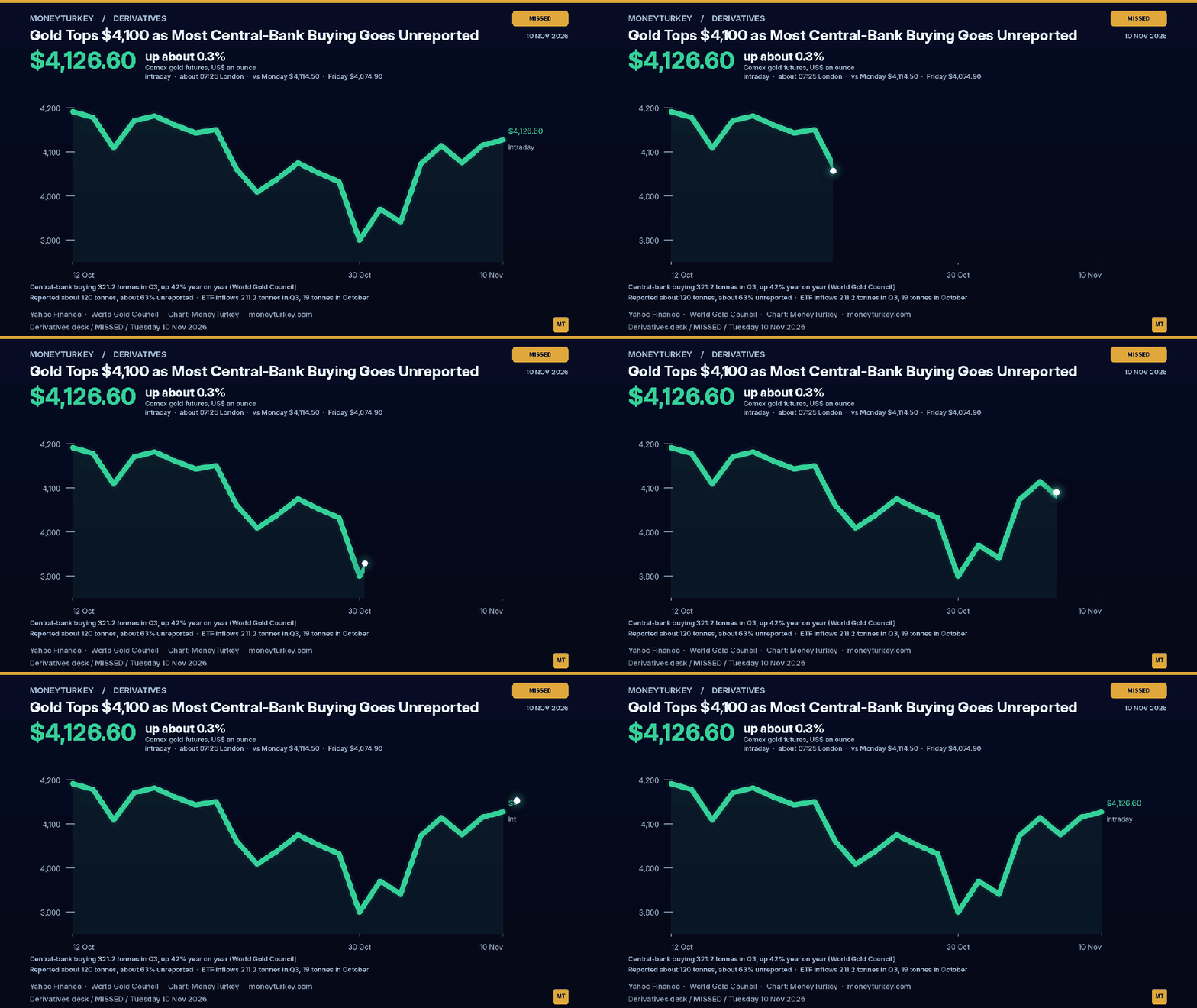
Gold futures held above $4,100 an ounce on Tuesday morning, and the latest World Gold Council figures show that most of the central-bank buying behind the market is never publicly reported.
MoneyTurkey Derivatives Desk | 10 November 2026
Key points
- Comex gold futures were at $4,126.60 an ounce at about 07:25 London time, up about 0.3% from Monday’s close of $4,114.50 and up from $4,074.90 on Friday, according to Yahoo Finance data.
- Central banks and other institutions bought an estimated 321.2 tonnes in the third quarter, up 42% from a year earlier and above the five-year quarterly average of 227 tonnes, the World Gold Council said.
- Only about 120 tonnes of that was reported by individual central banks, led by China and Poland. The council estimates about 63% of the quarter’s buying was unreported.
What happened
Gold has flirted with a break below $4,000 in recent months and has struggled since its January record high, as US rate expectations shifted towards higher borrowing costs. A recent Mining.com op-ed said much of the speculative money has since been washed out of the market, leaving gold caught between competing short-term pressures.
The op-ed named weakness in equity markets as the main short-term risk, as investors question the AI investment boom after the US midterm elections, won overwhelmingly by Democrats, many of whom questioned the need for more energy-hungry data centres. Falling stock markets often force investors to sell other assets, including gold. The same piece argued that softer stocks and lower oil prices could move the Federal Reserve back towards a neutral stance, or even rate cuts next year, which would help gold. US crude futures were at about $85.62 a barrel, down from $90.83 on Friday.
The buyers you cannot see
Central-bank demand looks sensitive to price. Purchases were weakest in the first quarter, at 57.7 tonnes, when gold was at its peak, then rose to 296.3 tonnes in the second quarter and 321.2 tonnes in the third, according to World Gold Council data. Year-to-date buying reached 675 tonnes, 6% ahead of the same period in 2025.
The gap between reported and estimated buying has persisted since 2022, the council said, which means country-by-country disclosures give only a partial picture of who is buying. Investors have returned too: gold exchange-traded funds took in 211.2 tonnes in the third quarter, reversing a 47.3-tonne outflow in the second, and added 19 tonnes in October.
What to watch
- Whether gold futures hold above $4,000
- Monthly ETF flow data from the World Gold Council
- US inflation data and Fed rate expectations
For information only. Not investment advice.
Sources
- Yahoo Finance market data (gold and crude futures, about 07:25 London time): finance.yahoo.com
- World Gold Council: Gold Demand Trends Q3 2026, central banks
- World Gold Council: Gold Demand Trends Q3 2026
- Mining.com: Gold’s short-term volatility contrasts with long-term bullishness

