
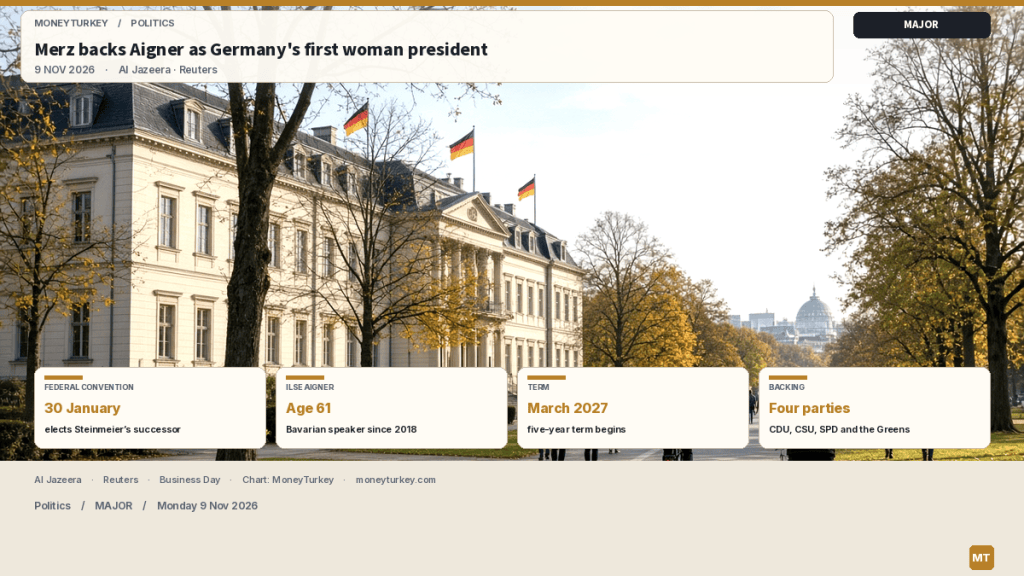
Chancellor Friedrich Merz nominates Bavarian conservative Ilse Aigner to replace President Frank-Walter Steinmeier, with coalition backing.
MoneyTurkey Politics Desk | 9 November 2026
Key points
- Merz announced the pick at a CDU leadership dinner on Sunday, 8 November, then presented Aigner alongside him after a CDU leadership meeting in Berlin on Monday, 9 November.
- Aigner, 61, speaker of the Bavarian parliament and former agriculture minister under Angela Merkel, would be elected by the Federal Convention on January 30.
German Chancellor Friedrich Merz will nominate Bavarian politician Ilse Aigner for the country’s next president, making her the first woman to hold the post if elected. Merz made the announcement on Sunday, 8 November, at a dinner for leaders of his centre-right Christian Democratic Union. Aigner, speaker of the Bavarian state parliament and a member of the Christian Social Union, has the backing of the CDU, CSU and the Social Democratic Party, the three parties in Germany’s governing coalition. The Federal Convention will vote on the successor to incumbent Frank-Walter Steinmeier on January 30.
What happened
Merz’s nomination ends weeks of internal discussion between the CDU and CSU over the choice of candidate. The CSU had put forward Aigner’s name earlier this year, but the CDU delayed endorsement while Merz considered alternatives, straining relations between the two sister parties. With the SPD also backing Aigner, the coalition now has a common candidate, in line with German political practice.
Aigner, 61, trained as an electrical engineering technician and worked in electrical systems development for helicopter maker Eurocopter before entering politics. She was elected to the federal parliament in 1998, served as agriculture minister under Angela Merkel, and returned to Bavaria to become speaker of the state parliament in 2018. If elected, she would serve a five-year term beginning in March 2027, when Steinmeier reaches the limit of two terms.
What the role involves
The German president’s role is largely ceremonial, limited to signing legislation and formally appointing ministers. However, the head of state is expected to provide a moral voice beyond daily politics and act as a neutral arbiter above party lines. Aigner said she would work to overcome divisions in German society, noting that “our country and our democracy are under attack from within and without” and that “extremists are celebrating their triumphs.”
Merz praised Aigner’s “clear commitment to the fundamental values of our democracy” and her opposition to hatred and extremism. A senior SPD member described her as “an experienced, down-to-earth politician” who could bring Germans together. The Greens’ leadership urged support for her nomination “for cohesion, mutual respect and strengthening the democratic centre beyond party boundaries.”
Why it matters
Germany’s mainstream parties are contending with the rise of the far-right Alternative for Germany party, which opinion polls suggest could become the biggest party after the next federal elections, due in early 2029. Aigner’s nomination signals an effort by the governing coalition to present a candidate who can appeal across party lines and reinforce the democratic centre.
The president is elected by the Federal Convention, made up of members of the lower house of parliament and delegates from Germany’s 16 federal state parliaments. With the support of the CDU, CSU, SPD and Greens, Aigner is expected to secure the required majority in January.
What to watch
- Whether any other party fields a rival candidate
- Federal Convention vote on January 30
- Aigner’s first statements on domestic and EU policy after election
Related on MoneyTurkey
- South Africa ANC Coalition Shift After Vote Rebuke
- Trump expects Xi and Putin talks at APEC as China extends its US tariff pause
For information only. Not investment advice.
Sources
- Al Jazeera: https://www.aljazeera.com/news/2026/11/8/chancellor-merz-to-nominate-aigner-as-germanys-first-woman-president
- Business Day: https://www.businessday.co.za/world/europe/2026-11-09-germany-set-to-elect-first-female-president/
- Reuters: https://www.reuters.com/world/germany-set-get-its-first-female-president-after-merz-backs-bavarian-2026-11-09/
- Bloomberg: https://www.bloomberg.com/news/articles/2026-11-08/merz-backs-ilse-aigner-as-germany-s-first-female-president

