
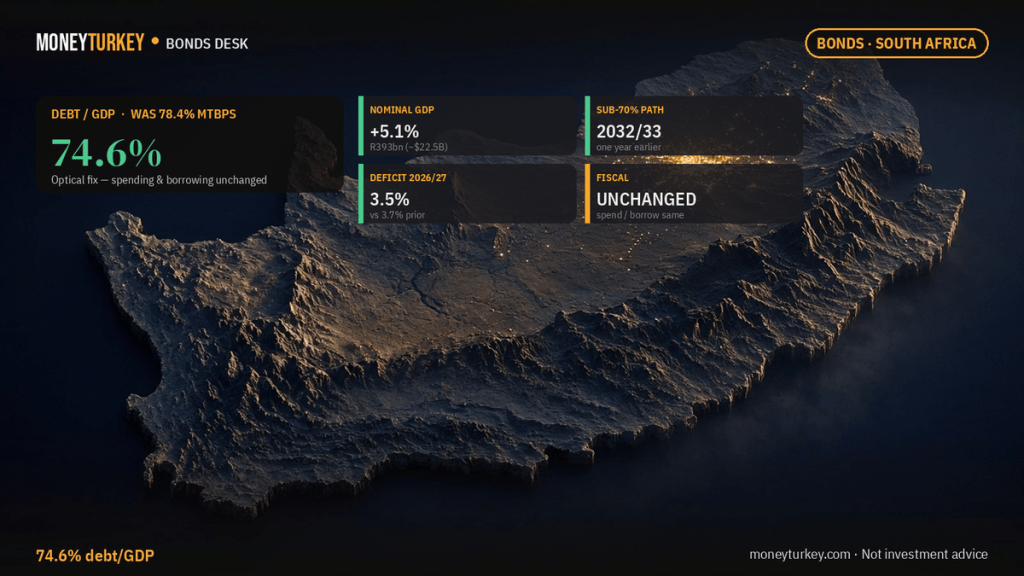
South Africa’s National Treasury says Stats SA’s GDP rebase cut the debt-to-GDP ratio on paper — borrowing plans are unchanged.
MoneyTurkey Bonds Desk | 5 November 2026
Key points
- Stats SA’s 2026 rebasing raised nominal GDP by 5.1% (R393 billion, ~$24 billion), mechanically lowering the 2025/26 debt-to-GDP ratio to 74.6% from the 78.4% projected in the MTBPS.
- Debt-to-GDP is now expected to fall below 70% by 2032/33 — one year earlier than previously forecast — while the 2026/27 main budget deficit improves to 3.5% of GDP from 3.7%.
South Africa’s National Treasury updated its fiscal ratios after Statistics South Africa’s 2026 GDP rebasing and benchmarking exercise lifted the level of nominal GDP by 5.1%, or R393 billion (~$24 billion at ~R16.36/$). The mechanical adjustment lowered the debt-to-GDP ratio to 74.6% in 2025/26 from the 78.4% estimated in the 2026 Medium Term Budget Policy Statement. The Treasury stressed that revenue, spending and debt-stock forecasts are unchanged; only the denominator has been revised.
What happened
Stats SA released the revised GDP figures on 29 October 2026. National Treasury recalculated its ratios on the new base and published the results on Thursday. The benchmarking exercise incorporates improved data and methods to reflect structural changes in the economy.
The debt-to-GDP ratio is now projected to drop below 70% by 2032/33, a year earlier than the MTBPS forecast. The main budget deficit for 2026/27 improves to 3.5% of GDP from 3.7%, while the primary surplus is revised to 1.6% of GDP from 1.7%. Over the medium term, the consolidated budget deficit improves by an average of 0.2 percentage points of GDP.
What is moving yields
Director-General Duncan Pieterse said the updated calculations confirm that government continues to achieve its fiscal targets and that South Africa is seeing the benefits in lower borrowing costs. The Treasury statement did not provide specific yield levels or spread changes.
The revised ratios do not alter government’s revenue, spending or debt projections. The 2027 Budget will include updated economic forecasts and fiscal projections based on the new GDP data.
Why it matters
A larger measured economy reduces fiscal ratios that use GDP as the denominator, improving the appearance of debt sustainability without any change in actual borrowing. Historically, Stats SA’s five-yearly benchmarking exercises have often increased the estimated size of the economy but have seldom affected growth rates meaningfully — an optics move EM bond desks still reprice when rating committees refresh their models.
The Treasury said the stronger metrics provide a firmer foundation for investment and growth. Market participants will watch the 2027 Budget for any revisions to issuance plans or debt-service forecasts that could affect South African government bonds and eurobonds.
What to watch
- 2027 Budget for updated issuance and debt-service forecasts
- Any follow-up statements from the Treasury or Stats SA on further data revisions
- Investor reaction in the secondary market for South African rand bonds and eurobonds
Related on MoneyTurkey
- Indian Bonds Rally Most Since April as Oil Slides After Midterm Sweep
- ECB Holds Deposit Rate at 2.5%
For information only. Not investment advice.
Sources
- South African Government News Agency: https://www.sanews.gov.za/south-africa/revised-gdp-figures-improve-key-fiscal-ratios
- Bloomberg: https://www.bloomberg.com/news/articles/2026-11-05/south-africa-debt-ratios-lowered-by-data-overhaul-treasury-says

