
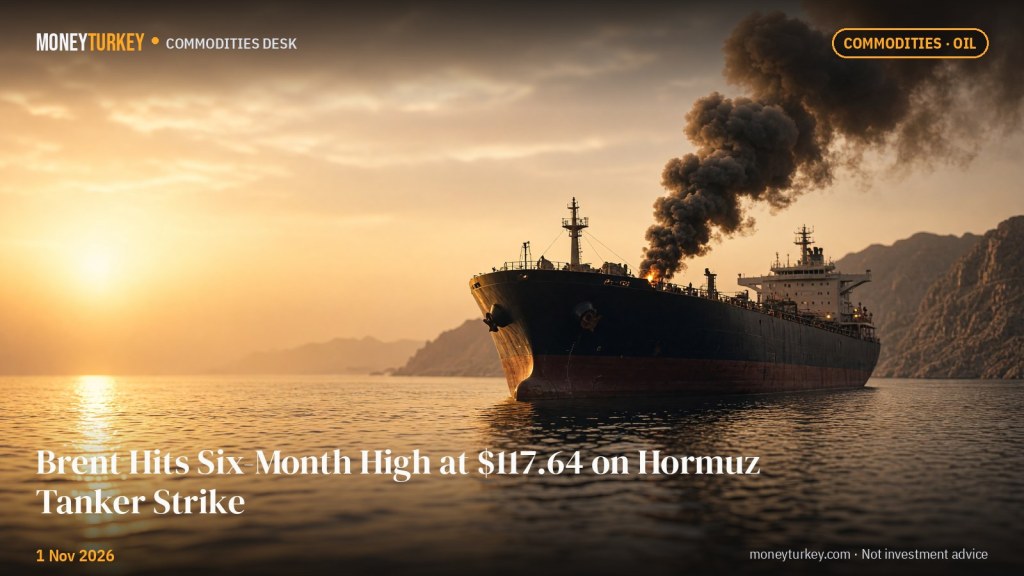
A tanker attack in the Strait of Hormuz and fresh Houthi strikes on Saudi facilities lifted Brent 2.4% to its highest close since April.
MoneyTurkey Commodities Desk | 1 November 2026
Key points
- Brent December futures settled up $2.76 at $117.64 a barrel, the highest close since the end of April.
- A tanker in the Strait of Hormuz was struck by limpet mines attached from a small boat, the first such confirmed attack since the US-Israeli war with Iran began in February.
Brent crude futures for December settled at $117.64 a barrel on Friday, up $2.76 or 2.4%, after touching $118 intraday. The January contract rose $2.63 to $113.43. WTI finished at $104.12, up $2.12 or 2.08%. The gains came after a tanker was struck by explosive devices attached from a small boat in the Strait of Hormuz, the key outlet for Gulf crude exports.
What happened
The UK Maritime Trade Operations agency reported the tanker was hit by limpet mines in the Strait of Hormuz. It was the first known successful strike using this method in the waterway since the conflict began in February. The UKMTO also recorded a projectile striking a tanker leaving the strait and another vessel catching fire south of Iran’s Lavan Island.
Iran’s Islamic Revolutionary Guard Corps said four oil tankers caught fire following incidents in or near Hormuz, including vessels that struck naval mines after entering unauthorized routes. The claims could not be independently verified. A tally of UKMTO reports showed at least 35 attacks on shipping in the Gulf and Hormuz during October, the highest monthly count since the conflict began.
The US embassy in Riyadh ordered non-emergency government employees and their family members to leave Saudi Arabia effective October 23, citing Houthi attacks on civilian airports and other critical infrastructure. Yemen’s Iranian-backed Houthi militants said they had attacked several sites in Saudi Arabia, including the Ras Tanura oil refinery, the Rabigh refinery and a production facility in Abqaiq owned by Saudi Aramco.
What is driving prices
Traders focused on oil flows out of the Middle East and the risk of further escalation by US and allied forces, according to Dennis Kissler of BOK Financial. Shipping traffic through the strait remains sharply depressed, with UKMTO recording 122 outbound and 155 inbound transits in the week through October 28, roughly 70% below pre-war levels.
Asian spot LNG prices rose for a fourth consecutive week to a new multi-year high on persistent geopolitical tensions in the Middle East. The average LNG price for December delivery into northeast Asia was $32.50 per million British thermal units, up from $30.50 the week before. In Europe, the Dutch TTF gas price settled at $33.97 per mmBtu, posting a weekly gain of 10.7%.
Weather forecasts in Asia and Europe shifted colder in the last week, creating more winter demand and increasing competition for LNG cargoes. Uncertainty over the duration of the cold spell, combined with ongoing geopolitical tensions, added to the market volatility. Saudi Arabia’s crude exports rose in October from September, two of three ship-tracking companies said, despite Iranian attacks on shipping in the Gulf.
Why it matters
The Strait of Hormuz is the key sea outlet for Gulf crude and fuel supplies. Any sustained disruption to tanker traffic would tighten global supply at a time when the US oil rig count rose by two and US crude oil output increased in August while demand for crude oil and petroleum products declined, according to the EIA’s Petroleum Supply Monthly report.
Qatari mediators returned to Tehran on Friday as part of coordinated efforts to reach a deal between the US and Iran. US President Donald Trump said Vice President JD Vance had reached out to Iran to help the country get medical supplies. Iran has received a letter from Vance but has not responded yet, Iran’s semi-official Tasnim news agency reported, adding that Tehran wants the US to meet its conditions.
Oil prices could become even more volatile in the next couple of weeks due to Israel’s recent elections and the US midterm elections on November 3, according to a Saxo Bank briefing. Reports that US military officials briefed Trump on options for additional strikes, potentially after Tuesday’s midterm elections, highlighted the risk of renewed fighting.
What to watch
- US midterm elections on November 3 and any post-election policy moves
- Qatari-mediated talks between US and Iran in Doha or Istanbul
- Further attacks on shipping in the Strait of Hormuz or Gulf
- Weekly LNG price updates for northeast Asia and Europe TTF
For information only. Not investment advice.
Sources
- CNBC: https://www.cnbc.com/2026/10/30/oil-rises-on-supply-concerns-as-houthis-attack-saudi-arabia.html
- Yahoo Finance: https://finance.yahoo.com/energy/articles/oil-hits-six-month-highs-063746684.html
- Gulf Times: https://www.gulf-times.com/article/737152/business/oil-jumps-2-settles-at-6-month-high-on-fears-of-iran-war-escalation
- Reuters: https://www.reuters.com/business/energy/oil-rises-supply-concerns-houthis-attack-saudi-arabia-2026-10-30/
- WSJ: https://www.wsj.com/finance/commodities-futures/oil-declines-on-likely-technical-correction-ad4be59e
- The National: https://www.thenationalnews.com/business/markets/2026/10/30/oil-prices-set-for-sharp-monthly-rise-on-hormuz-strikes-and-us-threat-to-hit-iran/

