
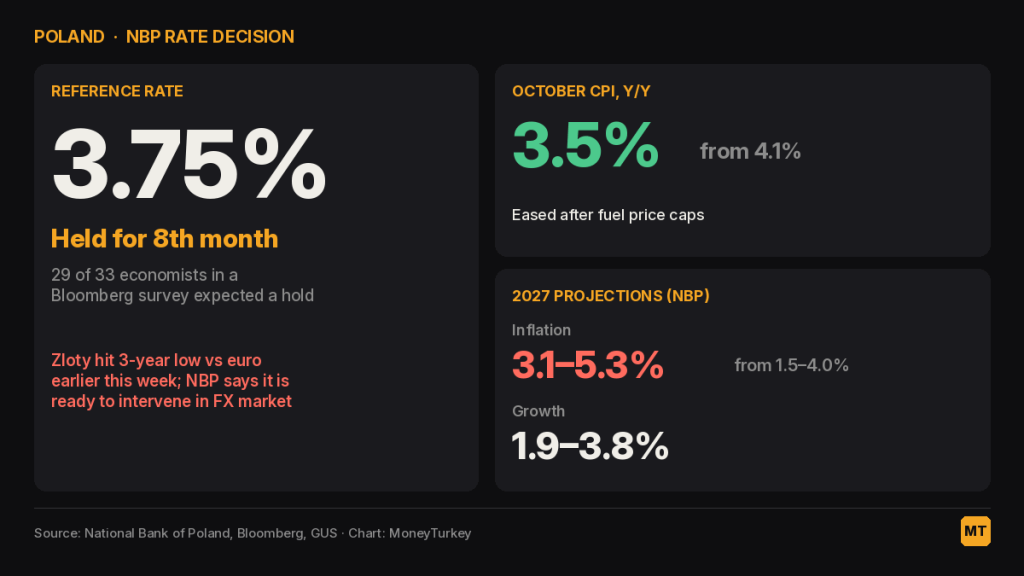
Fuel caps pulled headline inflation back inside the target band, giving the Monetary Policy Council cover to extend its pause.
MoneyTurkey Currencies Desk | 4 November 2026
Key points
- Poland’s central bank left its benchmark rate unchanged at 3.75% for the eighth straight month, matching 29 of 33 economists surveyed by Bloomberg.
- October headline inflation fell to 3.5% year-on-year from 4.1% in September after the government reinstated fuel-price caps.
Poland’s Monetary Policy Council kept its benchmark interest rate at 3.75% for an eighth consecutive month on Wednesday. The decision aligned with the majority of economist forecasts and came after renewed government fuel subsidies helped pull headline inflation back inside the central bank’s tolerance band. The pause follows a period of cooling domestic demand and rising political tension around Governor Adam Glapinski.
What happened
The ten-member council voted to leave the policy rate unchanged, brushing aside minority calls for a 25 basis-point hike. Bloomberg reported that 29 of the 33 economists it surveyed had expected no change.
Consumer price inflation eased to 3.5% year-on-year in October from 4.1% in September, according to Investing.com. The drop followed the government’s decision to re-impose caps on fuel prices, which brought the headline index back to the upper edge of the central bank’s tolerance band. Core inflation, excluding food and energy, also moderated during the month.
Third-quarter economic data showed a broad slowdown. Enterprise employment contracted on an annual basis, construction output fell, and GDP growth cooled. Retail sales and industrial production posted modest annual gains in September, but the overall picture reinforced the council’s wait-and-see stance.
What is driving the currency
The zloty weakened to a three-year low against the euro earlier this week, according to Investing.com. The slide came amid an institutional standoff over a looming parliamentary vote that could suspend Governor Glapinski, on top of external commodity volatility.
The council’s updated NECMOD projection showed a higher medium-term inflation path. The November forecast puts annual inflation between 3.1% and 5.3% in 2027, up from the July range of 1.5% to 4.0%. Growth is now seen between 1.9% and 3.8% next year. The upward revision to the inflation outlook limits the scope for near-term rate cuts.
The bank reiterated that future policy moves will depend on incoming data and the path of fiscal policy. It flagged regulatory energy measures and wage momentum as key inflation risks and said it stands ready to intervene in the foreign-exchange market to preserve financial stability.
Why it matters
For the zloty, the council’s readiness to step into the FX market is the key line. The central bank is signalling it will not let political noise turn into a disorderly slide against the euro. The higher inflation path projected for 2027 also makes rapid rate cuts less likely, which could lend the currency some support.
The fuel-cap effect on headline inflation is temporary. Once the subsidies fade, any rebound in energy prices could push the index back above the tolerance band and reopen debate on the timing of the first hike or cut. Markets will therefore watch monthly CPI releases and any updates to the government’s energy-support package for the next policy signal.
Political risk remains a live variable. A parliamentary vote on Glapinski’s suspension could trigger further zloty volatility if the outcome looks uncertain or if it raises questions about central-bank independence. Traders are therefore monitoring both the legislative calendar and any statements from council members that might clarify the conditions for FX intervention.
What to watch
- NBP core inflation data for October and the November flash CPI
- Parliamentary vote on Governor Glapinski’s suspension
- Any Ministry of Finance update on fuel-subsidy extension
- The next NBP projection round
Related on MoneyTurkey
- ECB’s Nagel Signals December Rate Hike
- Won firms to 1,341 as Korea’s $65bn NPS swap line nears year-end expiry
For information only. Not investment advice.

